


Why Did My Group Health Insurance Renewal Increase? What Employers Should Look At

Why did my group health insurance renewal increase?
Receiving a higher group health insurance renewal can be frustrating, especially when your company has worked hard to manage employee benefits costs throughout the year.
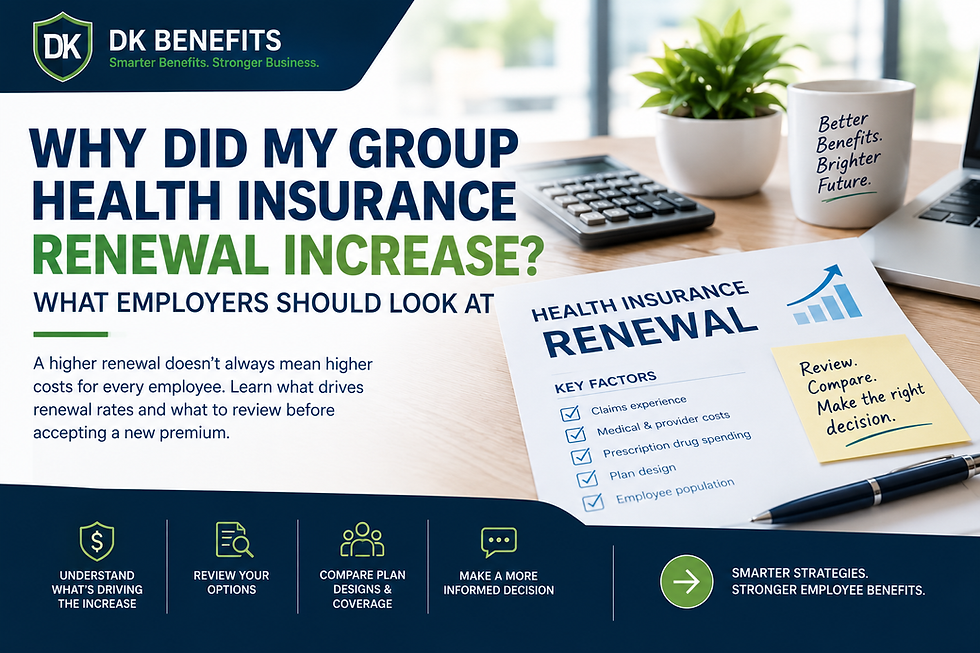
A renewal increase can happen even when your employees haven't experienced major changes in coverage. Insurance carriers consider several factors when calculating renewal rates, including claims experience, healthcare costs, prescription drug spending, plan design, and the overall risk of the group.
The important thing is not to look at the renewal increase as simply a new premium number.
Employers should understand what is driving the increase and review their options before making a decision.
Why Did My Group Health Insurance Renewal Increase?
There isn't always one reason behind a higher renewal.
A carrier may consider the group's claims experience, healthcare utilization, prescription drug costs, medical cost trends, and other factors when determining renewal pricing.
For employers, the first step is understanding what's actually behind the proposed increase.
Here are several areas to review.
1. Your Group's Claims Experience
Claims experience is one of the most important areas to examine during renewal.
A year with several large medical claims can affect the overall cost of a group health plan.
Examples can include:
Hospitalizations
Surgeries
Cancer treatment
Serious injuries
High-cost specialty care
Other significant medical conditions
A relatively small number of high-cost claims can have a meaningful impact on a group's healthcare spending.
This is why employers shouldn't assume that a renewal increase means every employee's healthcare costs have increased equally.
2. Rising Medical and Provider Costs
Healthcare services can become more expensive over time.
Hospital services, physician services, procedures, and other medical care can contribute to higher overall health plan costs.
Even if your company's employee population hasn't changed significantly, increases in the underlying cost of healthcare can affect the price of group coverage.
When reviewing a renewal, employers should therefore look beyond the percentage increase and ask what assumptions or cost trends are reflected in the renewal.
3. Prescription Drug Spending
Prescription drugs are another important part of the renewal conversation.
Certain medications can represent significant health plan spending, particularly specialty medications and other high-cost therapies.
Employers should review how prescription drug spending is affecting the overall plan and whether there are opportunities to improve pharmacy benefit management.
This can include looking at:
Formulary design
Pharmacy networks
Generic utilization
Specialty medications
Prescription drug trends
Pharmacy benefit management
Our guide to Understanding Pharmacy Benefit Managers (PBMs): What Employers Need to Know provides more information about how PBMs fit into employer prescription drug benefits.
4. Changes in Healthcare Utilization
The number of employees and dependents enrolled in a plan doesn't tell the entire story.
How people use healthcare can also affect plan costs.
For example, employers may want to understand whether there have been changes in:
Emergency room utilization
Hospital admissions
Outpatient procedures
Specialist visits
Preventive care
Prescription utilization
Understanding utilization patterns can help employers identify whether the renewal reflects a temporary issue or a broader trend.
5. Changes in Your Employee Population
Changes in the size or composition of a workforce can also affect a group health plan.
A company may have added employees, experienced turnover, changed its mix of employee and dependent enrollment, or experienced other changes during the year.
These changes can affect the overall risk profile and claims experience of the group.
That doesn't necessarily mean a workforce change caused the renewal increase, but it is an area worth reviewing with your broker.
6. Your Current Plan Design
Sometimes the renewal conversation isn't simply about whether the premium increased.
It's also about whether the current plan is still the right fit.
Employers should review:
Deductibles
Copays
Coinsurance
Out-of-pocket maximums
Provider networks
Prescription benefits
Employee contributions
Employer contributions
A higher premium may look very different when the underlying benefits are compared with alternative plan designs.
This is why employers should evaluate total benefits value, rather than looking at the renewal percentage alone.
7. Your Renewal Is Not Necessarily the End of the Conversation
Receiving a renewal proposal doesn't necessarily mean an employer has to accept the first option presented.
Depending on the situation, employers may be able to evaluate alternative plan designs, contribution strategies, network options, or funding arrangements.
Some employers may also explore alternatives such as:
HDHP and HSA options
Level-funded health plans
Self-funded health plans
Different provider networks
Alternative plan designs
Pharmacy benefit strategies
Each option has different financial and employee considerations, so changes should be evaluated carefully rather than based solely on the lowest premium.
For more information, see Self-Funded vs. Fully Insured Health Plans: What Employers Need to Know and What Is a Level-Funded Health Plan? A Guide for Small Businesses.
What Should Employers Ask When Reviewing a Renewal?
When your renewal arrives, don't just ask:
"How much did our premium increase?"
Ask questions that help explain the increase.
For example:
What factors are driving the renewal?
How did our claims experience affect pricing?
Are there significant high-cost claims affecting the group?
How has prescription drug spending changed?
Are there alternative plan designs available?
How would changing deductibles or copays affect the premium?
Are there different network options?
Would another funding arrangement make sense for our company?
How would proposed changes affect employees?
What options should we evaluate before making a decision?
These questions can turn a renewal from a simple pricing exercise into a broader benefits review.
Don't Focus Only on the Premium Increase
A common mistake is to focus entirely on the percentage increase.
For example, a company might see a 15% renewal increase and immediately look for ways to reduce the premium.
But the better question is:
What is causing the increase, and what options do we have?
A lower premium may come with a higher deductible, different network, greater employee contributions, or other changes to the benefits package.
On the other hand, maintaining the existing plan may not always be the most appropriate option either.
The right decision depends on the company's budget, workforce, claims experience, and benefits objectives.
What Employers Can Do Before Accepting a Renewal
A renewal review can be broken down into several steps:
1. Review the renewal proposal.Understand the proposed rates and any changes to the plan.
2. Analyze the claims experience.Identify major cost drivers and utilization trends.
3. Review prescription drug spending.Look at pharmacy costs and potential opportunities for management.
4. Compare plan designs.Determine whether alternative designs could provide a better balance of cost and coverage.
5. Evaluate employee contributions.Understand how changes would affect both the employer and employees.
6. Review funding options.Depending on company size and circumstances, evaluate whether fully insured, level-funded, or self-funded options warrant consideration.
7. Prepare for employee communication.Any changes should be clearly explained before open enrollment.
How DK Benefits Can Help
A health insurance renewal is more than a new premium quote.
It is an opportunity to review your company's overall benefits strategy and determine whether your current plan still aligns with your budget and employee needs.
DK Benefits helps employers evaluate their group health insurance options, understand renewal changes, and explore strategies for managing benefits costs without losing sight of employee needs.
If your renewal is approaching, starting the review early can give you more time to understand your options and prepare for the next benefits year.
Key Takeaway
A higher group health insurance renewal can be driven by several factors, including claims experience, medical costs, prescription drug spending, healthcare utilization, and changes within the employee population.
Instead of simply accepting the renewal—or immediately looking for the cheapest alternative—employers should first understand why the renewal increased and what alternatives are available.
A thorough renewal review can help employers make more informed decisions about plan design, employee contributions, funding, and overall benefits strategy.


Comments